

Background of daylight saving time 2025
Every year many of us rely on the familiar phrase “spring forward, fall back” to remember the twice-yearly clock change under Daylight Saving Time (DST). For 2025, here are the key dates–and why the practice is under fresh scrutiny.
Key Dates for 2025
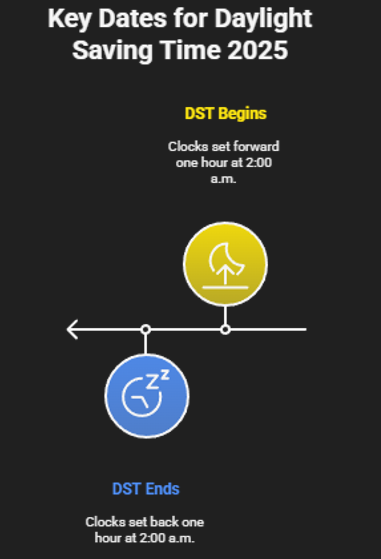
- In the United States (and most of Canada), DST begins at 2:00 a.m. on Sunday, March 9, 2025 when clocks will be set forward one hour.
- It ends at 2:00 a.m. on Sunday, November 2, 2025, when clocks are set back one hour.
- The rules: DST runs from the second Sunday in March until the first Sunday in November in the U.S. since 2007 (under the Energy Policy Act of 2005).
Origins and Purpose
- The idea of shifting clocks was first floated by Benjamin Franklin in 1784 (though somewhat tongue-in-cheek), and then more seriously proposed by builder William Willet in early 20th century.
- In the U.S., DST was first enacted in 1918 (during WWI) under the Standard Time Act to conserve fuel and energy by maximizing use of daylight.
- he standardization came with the Uniform Time Act of 1966.
Why We Should-And Shouldn’t-Keep DST in 2025
DST remains a mixed bag. On one hand, it promises later daylight in the evening; on the other, it brings hidden costs and disruptions.
The Upside: Extra Evening Light & Incentives for Activity
- By shifting clocks forward in March, we gain more daylight in the evening, which can encourage outdoor activity, reduce artificial lighting, and potentially boost retail/social engagement.
- For households, the “extra hour” in the evening can feel like a gift—longer daylight after work or school.
The Downside: Health, Circadian Disruption, & Questionable Savings
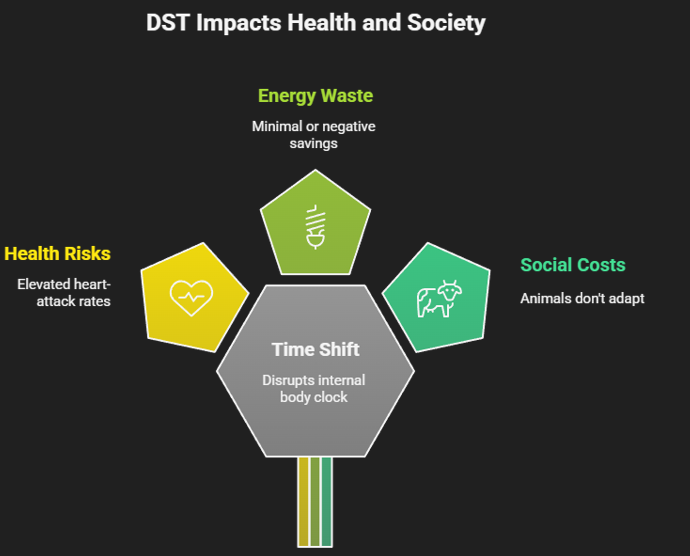
- Shifting time disrupts our body’s internal clock (circadian rhythm). Experts warn of risks: elevated heart-attack rates, increased traffic accidents, mood shifts, sleep disruption.
- Energy savings are minimal or even negative in modern contexts. Some studies show DST doesn’t deliver the fuel or lighting savings once expected.
- Social and biological costs: Farmers, for example, have historically objected because animals and agricultural schedules don’t adapt to clock-shifts as humans attempt to.
The 2025 Context: Heightened Debate
- In 2025 the debate is more prominent than ever: the Sunshine Protection Act, which would make DST permanent in the U.S., passed the Senate in 2022 but hasn’t become law yet.
- Polls suggest a majority of Americans favour eliminating the twice-yearly switch.
- More jurisdictions (states, provinces) are exploring either abolishing the change or sticking with standard time year-round. For example, parts of Canada like Ontario have legislation awaiting regional coordination.
What to Know & How to Prepare for 2025 daylight saving
Before the Spring Forward (March 9)
- Lose an hour of sleep when clocks jump ahead at 2 a.m.
- Start adjusting one to two days ahead: go to bed 15-30 minutes earlier; wake up earlier to smooth the shift.
- Light exposure: in the evenings, keep lights brighter; in the morning, make your wakeup routine bright for better circadian alignment.
- Update manual clocks, appliances, fitness trackers, car clocks. Many digital devices adjust automatically—but check.
Before the Fall Back (November 2)
- You’ll gain an hour of sleep—sounds positive—but expect earlier sunsets and darker evenings.
- Transition your bedtime one to two days ahead if possible.
- Exposure to morning light becomes more important—mornings will be lighter; evenings darker, which can impact mood and activity.
- Check outdoor light timers, security systems, automatic devices.
Year-Round Best Practices
- Maintain consistent sleep schedule as much as possible, even across switching-days.
- Use blackout/room-darkening curtains in case early sunrise or earlier darkness disrupts sleep.
- Encourage children’s routines to shift gradually rather than “cold turkey” on change-day.
- Track local sunrise/sunset times across the seasons—be aware of changing daylight exposure.
- If you live in a jurisdiction that does not shift clocks (or is considering abolishing DST), stay informed as laws may change.
Global & Regional Differences to Keep in Mind
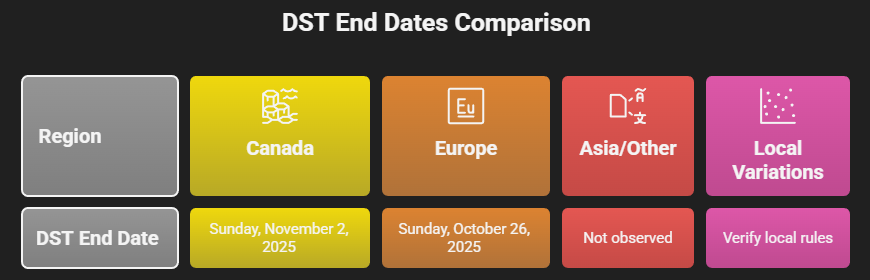
- In Canada, DST also ends on Sunday, November 2, 2025 in most regions.
- In Europe, DST ends earlier: for example, many European countries will shift back on Sunday, October 26, 2025.
- In Asia and other parts of the world, DST may not be observed at all (e.g., in India and many East Asian countries).
- Always verify local rules: even within countries, specific states/provinces may opt-out.
Why the Sentiment Is Negative for the Practice of DST
The promise of “saving daylight” or “saving energy” is increasingly seen as outdated in a world with LED lighting, changing work schedules, and modern lifestyles.
- The so-called “extra hour of evening” comes at the cost of more darkness in the morning or earlier night times—impacting mood, safety, driving visibility, and sleep quality.
- The twice-yearly disruption adds stress to children, shift workers, commuters, and the sleep-sensitive.
- The health impacts: cardiovascular risks, mood disorders, increased accidents following the time shifts.
- Because laws still require the switch, even if a region wants permanence, the limbo and uncertainty add complexity for planners, businesses, and individuals.
Looking Ahead: Will DST Survive the Year 2025 and Beyond?
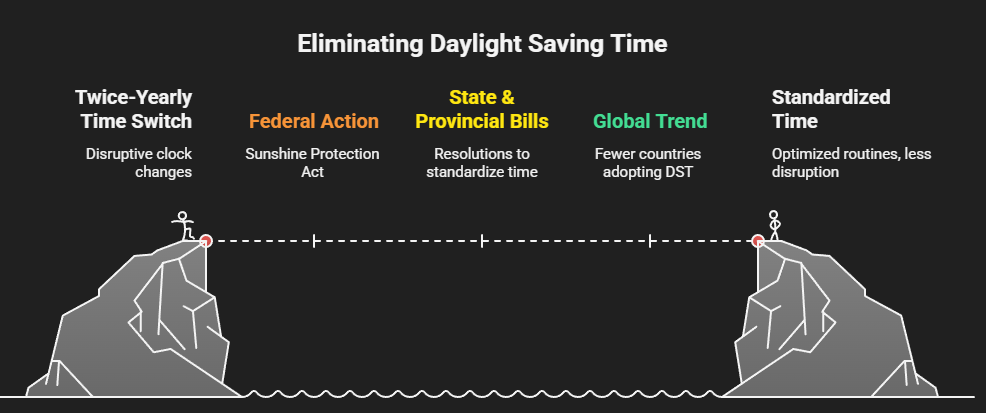
- The Sunshine Protection Act remains a key federal effort in the U.S. to make DST permanent. But federal law would need to change, and until then, the twice-yearly switch remains.
- More states and provinces are passing resolutions or bills to eliminate the change or standardize time year-round.
- The trend globally shows fewer countries adopting DST; for many regions it is increasingly seen as unnecessary.
- Businesses, governments and individuals will need to stay alert for legal changes or shifts in policy—which may still impact 2025 or shortly thereafter.
- Using 2025 as a “transition year,” many might begin optimising their routines to be less affected by the clock changes than before.
Final Thoughts
The clock change of 2025 (spring forward March 9, fall back November 2) is straightforward in terms of timing—but the human and societal implications remain complex. You may lose or gain an hour, but you also adjust your body clock, your sleep schedule, your daylight exposure, your mood, and your routines.
Given the mounting questions around the validity and value of DST—particularly in health, productivity, and energy-saving domains—the sentiment for continuing the practice in its current form is tilted toward negative. If you’ve been annoyed by the twice-yearly shift, 2025 may be another year to advocate for standard time year-round or for a system that doesn’t force us to flip the clock so abruptly.
