



Table of Contents
1. Background Context
The economic climate in the U.S. has embarked on a phase of high uncertainty. The state of persistent federal government shutdown, the cancellation of major data releases to the economy, and the recent reduction in the yields of the Treasury are all contributing to a difficult environment for investors and policymakers. Low yields on gains indicate increased worries about growth and inflation, and the Federal Reserve cannot make any decision due to the lack of fresh data. This mix of macroeconomic and policy risk implies that the safe assumptions previously used to determine the U.S. markets have more risk associated with them.
2. What’s Happening: Data Blackout, Shutdown & Yields Drop
Government Shutdown Disrupts Data & Confidence
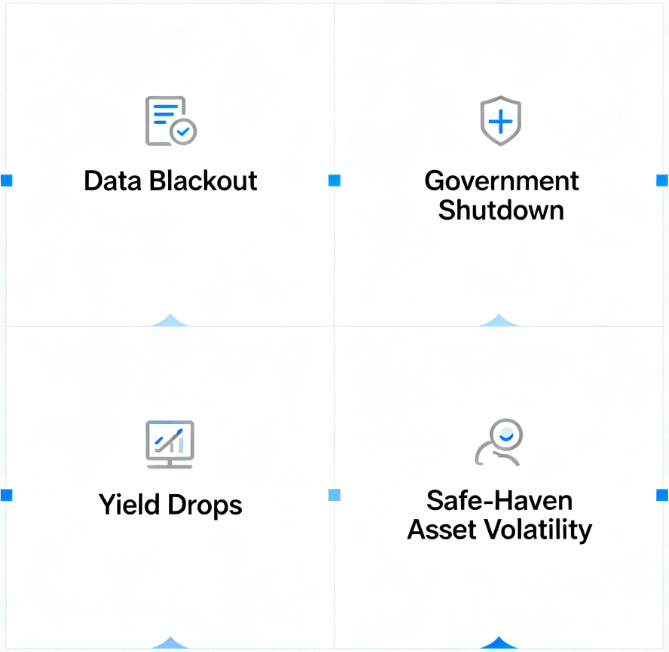
The federal government of the U.S. has been partially shut down since the beginning of October 2025 because Congress can no longer pass funding bills. As such, numerous federal agencies, such as the Bureau of Labor Statistics and the Bureau of Economic Analysis, have canceled most of their data releases. This data blackout, analysts warn, is crippling the capacity of the Fed and the market participants to evaluate the labor markets, inflation tendencies, as well as consumer and business activity. In addition, economic cost estimates indicate that it can cost up to $15 billion per week if the closure continues. Therefore, the U.S. economy is facing a triple threat of lacking data, stagnation of policies, and growth risk.

Treasury Yields Are Falling: A Signal of Caution
The 10-year U.S. Treasury yield decreased as on October 22, 2025, a new monthly low of 3.95% in the bond market. The last weekly review indicated the end of 10-year and 2-year yields at 4.01 and 3.46, respectively. The yields have dropped even when the labor market is tight, and this reflects that the investors are more skeptical of any near future growth or expect the monetary loosening. There is also a reduction in valuations in equities due to lower yields, especially high-growth stocks, which are sensitive to lower discount rates.
Safe-Haven Assets Under Pressure (But Still a Risk Signal)
As data obfuscation and policy risk increase, it can be expected that havens will rise. Indeed, gold had registered one of its biggest single-day losses in more than a decade of uncertainty. On the one hand, the decline in safe havens might seem rather counter-intuitive, but it highlights the fact that the market is in a state of a kind of state of an everything is fine feeling and a sense that something is amiss, giving the impression of a tense tranquility.
3. What Could Happen: Scenarios for U.S. Markets
Scenario 1: Volatile Market with Upside Surprise
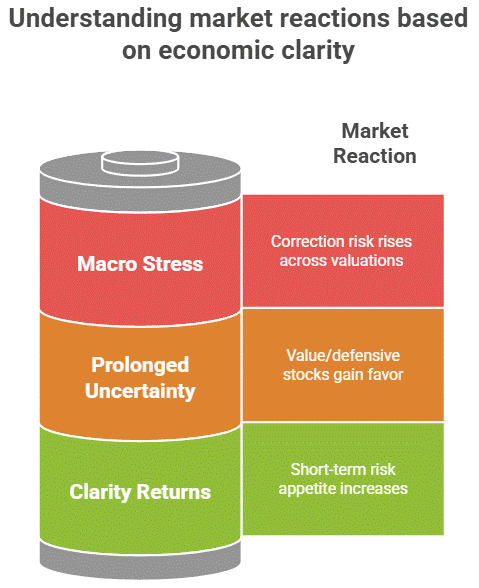
In case the shutdown ends in the near future, economic statistics resume, and yield level, the corresponding relief will cause a rally. Restoration of clarity could bring increased confidence among the investors, particularly when there is control over inflation and an increase in corporate earnings. In this scenario, equities might be able to spill over gains, especially in industries that require development and capital expenditure.
Scenario 2: Risk Premium Rises → Rotation and Caution
In case the shutdown continues, the data are still not available, and yields are also low (or even dropped further amid the increasing growth inequality), the markets will enter into risk-off mode. Stocks that have high valuations are prone to decline, and investors may shift to defensive or value areas. The entire market would come to a dead end without far-reaching involvement.

Scenario 3: Macro Stress → Pull-Back or Correction
In case yields rise once more (such as in the event of further acceleration in inflation) or a significant policy shock (such as an impasse in debt-ceiling negotiations or a credit ratings downgrade), the market might undergo a more steep pull-back. Lacking new data to prop up, the investor mood could turn negative and cause a correction or consolidation.
4. What This Means for the U.S. Investors
Keep Macro Risks Front of Mind
Macro factors that were initially background noise are being brought into the limelight. The risk is increased by the U.S. government shutdown, lack of data, and the stress on the yield. The investors need to keep an eye on the shutdown news, forthcoming data announcements, and yield curve changes.
Valuation Risk Rises
As valuations of most sectors are high, particularly growth stocks, the margin of error becomes low. Having macro clarity is good, and in case there is no such answer, the companies that are most optimistic about success are likely to disappoint initially. Look at leaning portfolio options out of overleveraged or highly valued names.
Diversify and Be Cautious
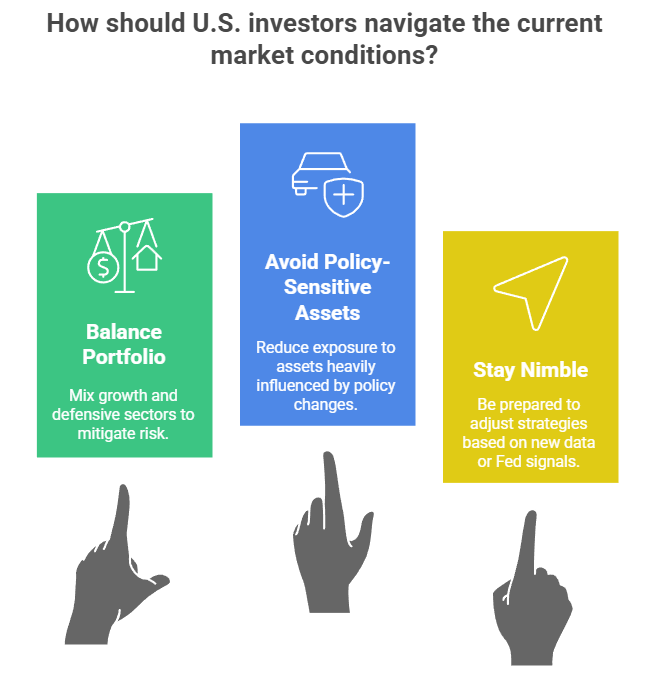
Enhanced diversification is more essential in such an environment. Balance the risk by using growth, defensive, and value sectors. Inclusiveness: Hedging or limiting exposure to volatile segments. Global spill-backs or policy shocks are not a pair of exceptions to the U.S. market.

Watch for Catalysts
With the information gap, markets will be susceptible to any incoming information. Earnings releases, CPI/PCE inflation data, and Fed commentary will be one-off events, as opposed to regular events. Stay prepared.
5. Quick Take & Action Points
- The U.S. macro-policy environment is changing: the government shutdown, data blackout, and low yields are the components that contribute to risk.
- Declining yields are indicative of growth issues, which is a threat to high-valuation stocks.
- U.S. investors: Recheck the allocation on policy-data susceptibility, allocate between growth and defensive/value, and expect higher volatility in the near future.
Action steps
- View Congress funding developments and close-up status.
- Follow the percentage change of the yield curve and inflation surprises.
- Increase portfolio weightings to sectors that are not significantly characterized by a macro dislocation.
- Any strong data release/policy articulation can also serve as a clue to repositioning.


2 thoughts on “3 Critical Macro Risks Shaping U.S. Markets Now”
Comments are closed.