


Background of Dog Leash Laws by State
Dog ownership in the U.S. brings joy, companionship, and responsibility. But one of the most misunderstood—and commonly violated—areas of pet ownership is leash law compliance.
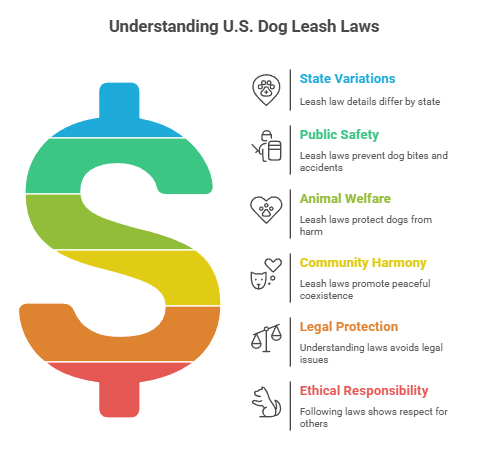
Every U.S. state has some form of leash or restraint requirement, though details vary widely. In some states, laws are uniform statewide; in others, counties and cities create their own ordinances. The purpose of leash laws is not just about control—it’s about public safety, animal welfare, and community harmony.
The CDC reports that more than 4.5 million dog bites occur annually in the U.S., and about 20% require medical attention. Many of these incidents could be prevented if owners followed local leash regulations.
Understanding your state’s leash laws helps protect you legally and ethically—and keeps your dog safe from traffic, wildlife, and potential altercations.

What Are Dog Leash Laws?
Leash laws are local or state regulations that require dog owners to restrain their dogs in public spaces. Depending on jurisdiction, “restraint” might mean:
- Using a leash of a specified length (often 6–8 feet).
- Keeping the dog under voice control or within a fenced area.
- Using a secure tether or enclosure on private property.
Failure to comply can lead to fines, liability for damages, or even impoundment.
Federal vs. State vs. Local Regulations
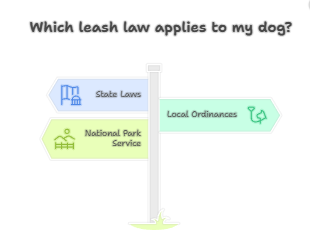
There is no federal leash law in the United States. Regulations come from:
- State laws: Set general rules or delegate power to counties and cities.
- Local ordinances: Define exact leash lengths, penalties, and exemptions.
- National Park Service regulations: Federal lands require pets to be leashed (usually ≤6 feet) or confined.
Example: In Yellowstone National Park, pets must be leashed and are not allowed on hiking trails or thermal areas for safety reasons.

State-by-State Overview (General Summary)
Northeast
- New York: Dogs must be leashed (≤6 ft) in all public areas unless designated off-leash by NYC Parks rules. Violations can result in fines up to $200.
- Massachusetts: State law leaves leash control to municipalities, though nearly all cities enforce leashes in public.
- Pennsylvania: State law (Dog Law 1982) requires owners to keep dogs “confined” or “under reasonable control.”
South
- Florida: Counties set leash laws. Most require dogs to be leashed in public; violation fines range from $50–$500.
- Texas: State law allows local regulation. Austin and Dallas have strict 6-foot leash ordinances.
- Georgia: Dogs must be under control at all times; dangerous dogs require specific restraint.
Midwest
- Illinois: All dogs must be on leash when off their owner’s property; owners can face civil liability for bites.
- Ohio: State law requires “reasonable control”; counties can impose additional leash mandates.
- Michigan: Leashes are mandatory off-property—penalties up to $500 or 90 days in jail for repeat offenders.
West
- California: No statewide leash law, but every county and city enforces its own ordinance. In Los Angeles, leashes ≤6 ft required in public.
- Colorado: Many counties allow off-leash recreation in designated dog parks only; otherwise, leashes are required.
- Oregon & Washington: State parks require leashes ≤6 ft; most cities follow similar rules.
Central & Mountain States
- Arizona: Dogs must be leashed or fenced; Maricopa County enforces a “leash at all times” rule.
- Utah: Leash laws vary; Salt Lake City requires leashes except in approved off-leash areas.
- Kansas & Nebraska: Dogs must be restrained or confined; violations can result in impoundment.
Alaska & Hawaii
- Alaska: Leash requirements depend on local boroughs; Anchorage enforces a 6-ft leash rule.
- Hawaii: State law mandates leashes ≤8 ft in public spaces. Violations can result in fines or impoundment.
Why Leash Laws Exist
Leash laws serve multiple crucial purposes:
- Public Safety: Prevents bites, fights, and accidents involving dogs and people.
- Animal Protection: Keeps dogs from traffic, wild animals, and toxic plants.
- Wildlife Conservation: Prevents dogs from chasing or harming wildlife.
- Legal Liability Reduction: Owners are less likely to face lawsuits or citations.
- Community Respect: Not everyone is comfortable around unleashed animals.
Penalties for Violating Leash Laws
Penalties vary by jurisdiction but often include:
- Fines: $25–$500 (first offense), higher for repeat offenses.
- Impound fees: Owners pay retrieval and boarding costs.
- Citations or court summons: For chronic or aggressive-dog violations.
- Civil liability: Owners pay damages if their unleashed dog harms a person or another pet.
Some states even classify severe violations (like attacks by unrestrained dogs) as misdemeanors or felonies.
Dangerous and Aggressive Dog Provisions
Many states have specific leash or restraint requirements for dangerous or potentially dangerous dogs.
For example:
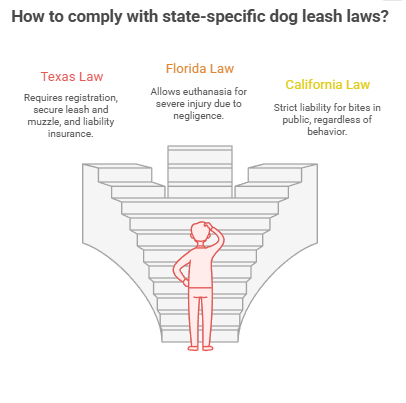
- Texas Dangerous Dog Law: Owners must register the dog, use a secure leash and muzzle in public, and maintain $100,000 in liability insurance.
- Florida Statute 767.13: Allows euthanasia of dogs causing severe injury when owners negligently fail to restrain them.
- California Civil Code 3342: Strict liability applies if an unleashed dog bites a person in public, regardless of prior behavior.

Leash Length and Type Requirements
Most jurisdictions specify:
- Maximum leash length: 6–8 feet (some parks limit to 4 feet).
- Acceptable types: Fixed leashes or sturdy retractable leashes; chains discouraged in many areas.
- Control expectation: Owner must maintain physical control; “voice control only” rarely suffices in public.
Specialty leashes—such as dual leashes for multiple dogs—must still comply with length rules.
Off-Leash and Dog Park Rules
Many cities offer designated off-leash parks or fenced play areas.
Common rules include:
- Current license and vaccination tags required.
- Dogs must remain under visual and voice control.
- Owners must clean up waste immediately.
- No aggressive dogs or females in heat.
Violations can result in suspension of park privileges or fines.
Leash Laws on Private Property
Leash laws extend beyond public spaces. Even on private property, owners must ensure dogs are:
- Confined by fencing, tether, or supervision.
- Unable to leave property boundaries.
Neglecting this can still result in civil liability if the dog escapes and causes harm.
Final Verdict
Leash laws in the United States are more than bureaucratic red tape—they’re vital tools for ensuring community safety, responsible ownership, and animal welfare. Whether you live in a bustling city or a quiet rural area, it’s your duty as a pet owner to understand and follow your local leash ordinances. A few extra seconds spent clipping on a leash can prevent serious accidents, protect wildlife, and keep your dog safe from harm or legal trouble. Responsible owners respect the leash not as a restriction, but as a simple act of love and safety toward their companion and community.

